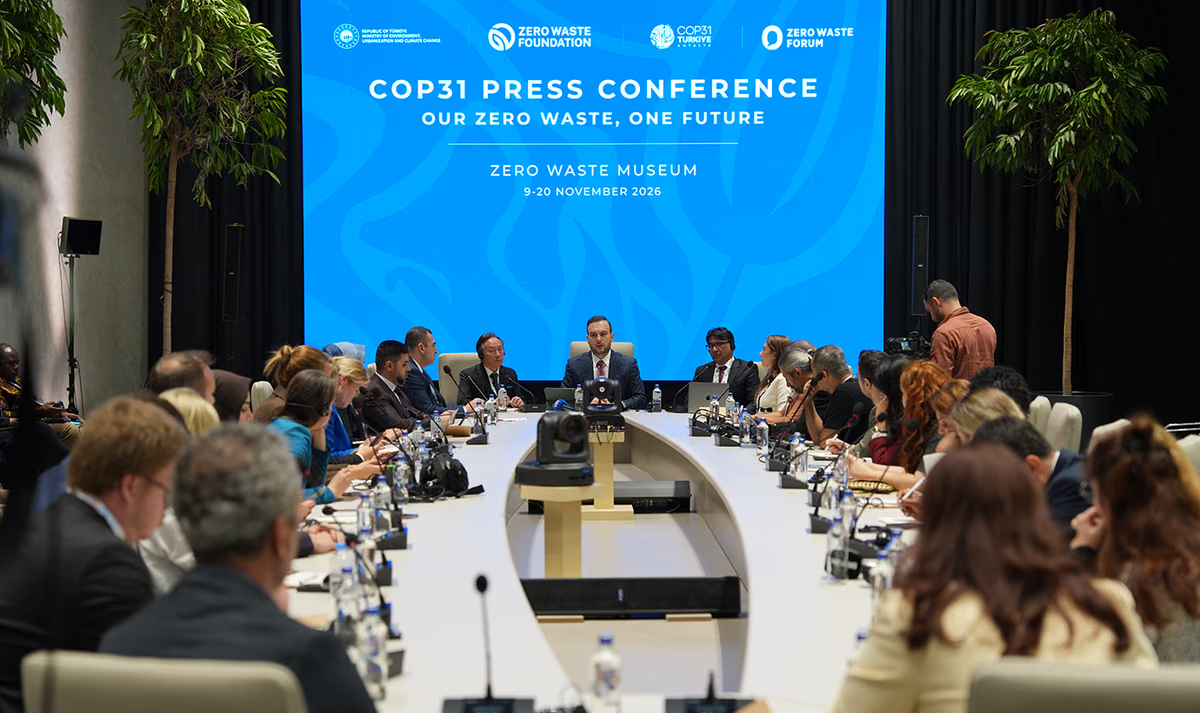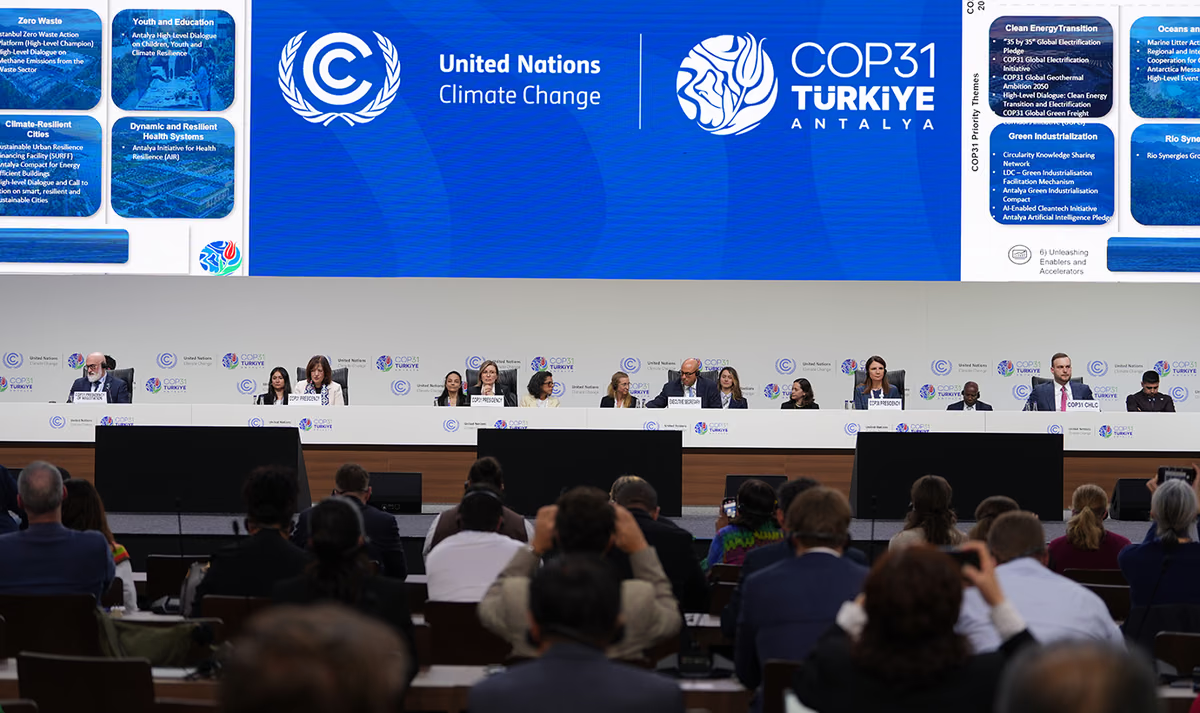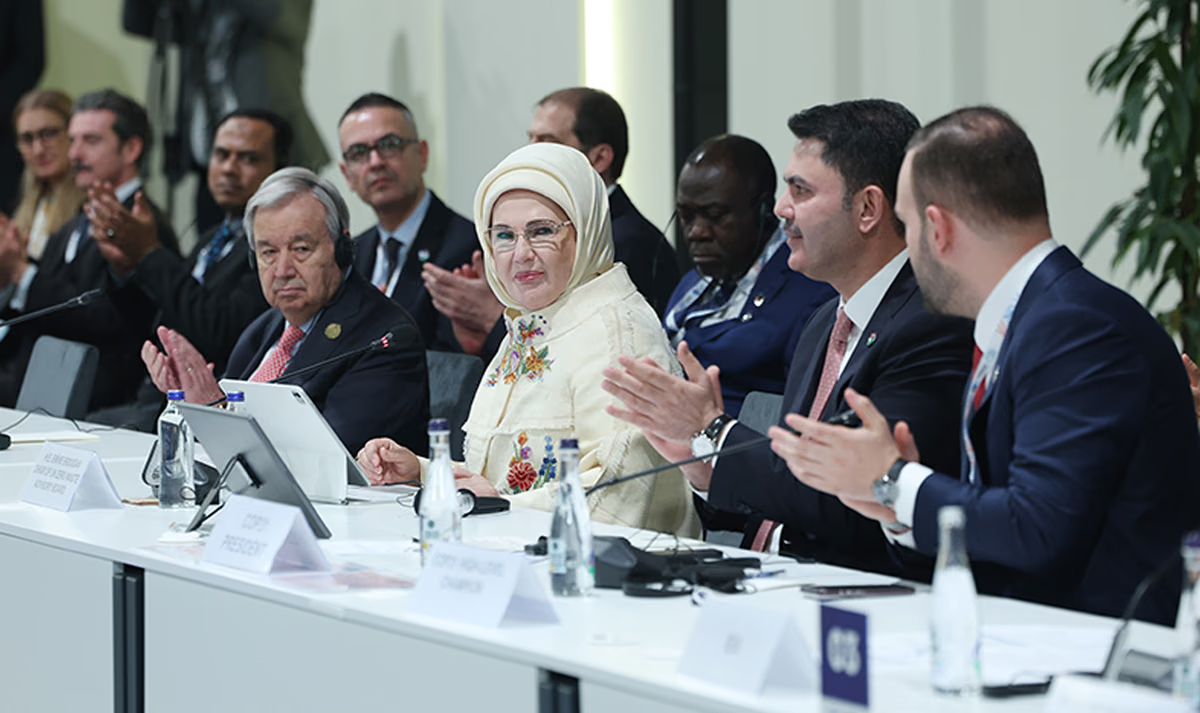
At the leaders’ meeting held within the COP31 Leaders’ Summit, Her Excellency Emine Erdoğan, Founder of the Zero Waste Movement, Chair of the United Nations High-Level Advisory Board on Zero Waste and Honorary President of the Zero Waste Foundation, drew attention to the cultural dimension of the waste crisis, the place of local knowledge in the fight against climate change and shared responsibility. Assessing problems ranging from food waste to methane emissions, Erdoğan called for zero waste practices to be carried into all areas of daily life.
The COP31 Presidency, the International Energy Agency (IEA) and the UN High-Level Advisory Board on Zero Waste organized the “Zero Waste, Circularity and Methane – Leaders’ Roundtable” within the COP31 Leaders’ Summit. Her Excellency Emine Erdoğan, Founder of the Zero Waste Movement, Chair of the United Nations High-Level Advisory Board on Zero Waste and Honorary President of the Zero Waste Foundation, attended the meeting.
In her speech, Emine Erdoğan expressed great pleasure at hosting the participants in Türkiye on the occasion of COP31 and thanked Murat Kurum, Minister of Environment, Urbanization and Climate Change, for the strong leadership shown during the COP31 Presidency; Samed Ağırbaş, President of the Zero Waste Foundation and COP31 Champion; and Fatih Birol, Executive Director of the IEA, who organized the meeting.
From a Single-Use Way of Life to a Growing Waste Burden
Her Excellency Emine Erdoğan recalled that in magazines of the early 1950s the “throwaway living” was praised and presented as humanity’s “golden age.” Referring to photographs in which disposable plates, cups, forks and knives are tossed joyfully into the air, she explained that use-and-throw items were glorified as a gift of the modern world that saved humanity time.
Noting that 40 percent of global waste today consists of single-use plastics, Erdoğan said an unprecedented increase in waste has occurred over the last half century. Pointing out that municipal solid waste is expected to double by 2050 and reach about 4 billion tons, she continued her assessment:
“If we consider this waste burden, which is almost impossible to manage, only as an environmental crisis, we would be addressing the issue incompletely. This is in fact a crisis of mindset. At the same time, it is a crisis of culture and civilization. It is proof that societies cannot walk into the future without accounting for what they leave behind. Therefore, the first step in the fight against climate change must be putting concepts and values in their proper place.”
The Link Between Food Waste and Methane Emissions
Stressing that the meaning attached between consumption and prosperity needs to be discussed, Erdoğan said: “Today, almost 30 percent of the food produced globally is wasted, but it does not end there. Food waste triggers many other intertwined crises. Knowing that just a quarter of all the food thrown away could feed almost 700 million people around the world who struggle with hunger is a moral dead end in itself.”
Noting that methane emissions are the main source of nearly one third of global warming to date, Erdoğan said 60 percent of these emissions come from human activities. She described the effects of individual behaviors adding up in these words:
“From produce discarded in the field for aesthetic reasons to fruit forgotten in the refrigerator because too much was bought, every action of ours in which we think ‘What could possibly happen from one apple thrown away?’ has major consequences in nature. Heavy costs are being paid as a result of the individual behaviors that millions of people consider insignificant adding up. This cost is paid at times by children who spend the day on an empty stomach, at times by people forced to leave their villages that have become uninhabitable for reasons related to climate change, or by species wiped off the face of the earth forever. If we want to untie this knot, first of all we must free this issue from being trapped in a technical language. We must build new value-based systems that people can connect with and take ownership of.”
The Role of Local Knowledge in the Fight Against Climate Change
Emphasizing the vital importance of the Zero Waste Movement at this point, Erdoğan said: “Because talking about Zero Waste is really talking about life. What will make people give up throwing bread away is not knowing greenhouse gas emission statistics but meeting again with the idea of blessing. Likewise, not throwing a plastic bottle or a cigarette butt on the ground is related to being able to see nature once again as a divine trust.”
Saying that the circular economy, renewable energy, resource management and zero waste are presented as new discoveries of our age, Erdoğan noted that these concepts form the backbone of local knowledge in almost every part of the world. Stating that she wished to give one of the best examples of this from Anatolia, which is practically a zero waste practice center, she continued her speech:
“Here, our elders say, ‘There is no new without the old.’ This saying sums up the essence of circularity for us in a single sentence. Making use of leftover food, storing produce that grows in its season, repairing broken things, mending clothes and extending their lives is the natural flow of life. When a seed is put into the soil, a prayer is said: ‘For the wolf, for the bird, for the one who eats.’ Because the understanding that ‘The world is our shared home’ is a way of life internalized in our culture. All these habits are shaped by respect for blessings, for labor and for the Creator. We see that local wisdom, which has developed a common language with nature, is practically a shield against the waste of natural resources, methane emissions, environmental pollution and the growing effects of climate change. Then we too must make local knowledge an active part of the fight against climate change, without letting it turn into a lost treasure.”
A Proposal on Compost and Raw Materials for Organic Waste
Noting that nature’s system is formed by the endless circulation of water, soil and air, Erdoğan conveyed the lessons that can be learned from nature and the targets regarding resource use in these words:
“Nature does not create waste; it uses its resources in the most efficient way. Throughout history, humanity has taken all its inspiration from nature. What we need to do now is again to take lessons from the school of nature. We can return the organic waste generated in our kitchens to the soil by composting it with extremely simple methods. In the same way, we can save large-scale organic waste generated in places such as workplaces, shopping centers, hotels and airports from becoming garbage. By turning this waste into fertilizer through composting, we can use it in landscaping and also use it as a raw material in animal feed production. We can only achieve our goal of reducing the projected increase in the global annual municipal solid waste amount by at least 50 percent by 2035 in this way. Likewise, the moment we start to see the materials we regard as waste as a new source of raw material, we can raise the circular material use rate to at least 15 percent.”
A Call to Broaden the Partners of Transformation
Erdoğan said she regards the meeting as an important opportunity to ensure goals do not remain on paper and that Zero Waste is adapted to every area of life. She voiced her call in this framework: “Let us only meet in the understanding that everyone has a duty in the fight against climate change. Let us make our local governments, our producers, our young people and our citizens active partners in this transformation. Let us together facilitate developing countries’ access to finance, technology, knowledge and capacity-building opportunities. Let us make lasting transformations, both with economic models that encourage the production of repairable products and with long-lasting product designs. Let us set out on a path where we will learn from one another by sharing our good practices and succeed all together.”
At the end of her speech, Emine Erdoğan wished that COP31 would bring good to all humanity.
Leaders and Representatives of International Organizations Came Together
Attending the program were Denis Sassou Nguesso, President of the Republic of the Congo; Tarique Rahman, Prime Minister of Bangladesh; Jonas Gahr Støre, Prime Minister of Norway; Russell Dlamini, Prime Minister of Eswatini; Paschal Donohoe, Managing Director of the World Bank Group; Nardos Bekele-Thomas, Chief Executive Officer of the African Union Development Agency; and İsmail Vild eş-Şeyh Ahmed, Secretary-General of the Organisation of Islamic Cooperation.
Among the participants were Murat Kurum, Minister of Environment, Urbanization and Climate Change; Aziz Abdukhakimov, Environmental Advisor to the President of Uzbekistan and Chairman of the State Committee for Ecology and Climate Change; Robert Eklo Kokou Tengue, Acting Minister in charge of Energy and Mineral Resources of Togo; Charafat Afilal, Minister of Energy, Mines and Sustainable Development of Morocco; Kaouter Krikou, Minister of Environment and Quality of Life of Algeria; Monique Barbut, Minister of Ecological Transition, Biodiversity and International Climate and Nature Negotiations of France; and Carlos Alberto Ramos Varela, Minister of Environment, Climate Action and Energy of Cabo Verde.
Also among those attending the meeting were Amna Al Dahak Al Shamsi, Minister of Climate Change and Environment of the United Arab Emirates; Takeshi Sekiya, Vice-Minister for Global Environmental Affairs of Japan; Arlette Bahati Tito, Deputy Minister of Environment and Sustainable Development of the Democratic Republic of the Congo; Maimunah Mohd Sharif, former Executive Director of UN-Habitat; Rachel Kyte, UK Special Representative for Climate; Ulrika Funered, Ambassador of Sweden to Türkiye; and Samed Ağırbaş, President of the Zero Waste Foundation and COP31 High-Level Climate Champion.