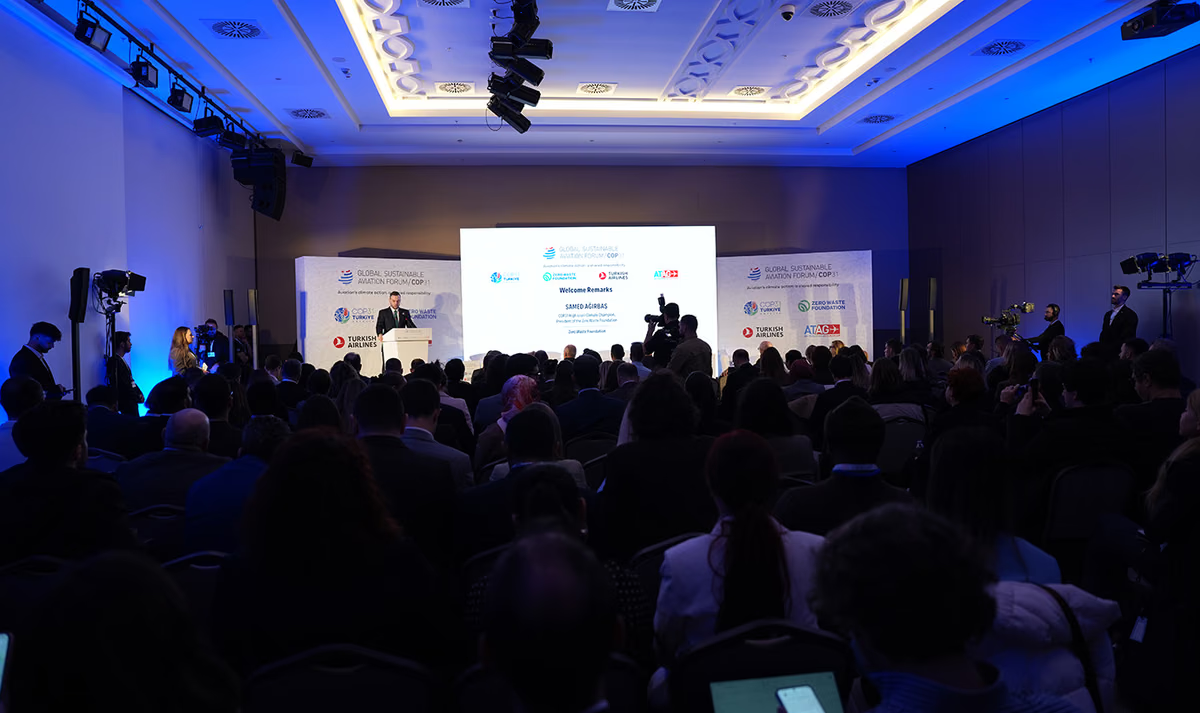
How the aviation sector can contribute to climate goals was discussed at the Global Sustainable Aviation Forum held as part of COP31. At the meeting, which brought together the Zero Waste Foundation and Turkish Airlines, sustainable fuels, technological innovations and common solutions applicable across the sector were put on the agenda.
Held with the strategic advisory support of the Air Transport Action Group (ATAG), the event was titled “Global Sustainable Aviation Forum: Aviation’s Climate Action: Shared Responsibility.” At the opening of the forum, held at the Convention Center in the COP31 Green Zone, Samed Ağırbaş, President of the Zero Waste Foundation and COP31 High-Level Climate Champion, and Ahmet Olmuştur, General Manager of Turkish Airlines, spoke.
A Call to Turn Targets into Measurable Projects
In his opening speech, Ağırbaş expressed the importance of international partnership with the words: “International cooperation is important for reducing environmental impacts in the aviation sector. Aviation connects families, businesses and countries.” He stated that reducing aviation’s environmental impact on the planet while preserving the connectivity it provides is a shared responsibility.
He stressed that airlines, airports, governments and oil producers must work together to develop cleaner fuels, increase energy efficiency and implement concrete solutions. As the COP31 High-Level Climate Champion, Ağırbaş said he wants to help turn cooperation into real projects with clearly defined responsibilities and measurable results.
A Zero Waste Approach from Terminals to Aircraft Cabins
Saying the zero waste understanding should be adopted in airport terminals, aircraft cabins, catering kitchens and other operational areas, Ağırbaş said: “The zero waste approach should be an integral part of efforts in the aviation sector.”
Ağırbaş referred to the place in Türkiye’s culture of valuing every crumb of bread and using resources with care. He noted that, under the leadership of Her Excellency Emine Erdoğan, this understanding has turned into a global zero waste movement.
Saying the aviation sector too can carry this message beyond borders and include it in its daily practices, Ağırbaş listed the steps that can be taken. He emphasized the importance of preventing food waste, spreading reuse and extending the useful life of valuable materials.
THY Continues Its Carbon-Neutral Airline Target for 2050
Ahmet Olmuştur, General Manager of Turkish Airlines, expressed their pleasure at hosting the forum in cooperation with the Zero Waste Foundation and with the strategic support of ATAG. Recalling that Türkiye is hosting COP31 for the first time, he described it as a valuable opportunity to contribute to the global fight against climate change and strengthen international cooperation.
Olmuştur said they organized the forum inspired by the approach of dialogue, consensus and action of Murat Kurum, Minister of Environment, Urbanization and Climate Change and COP31 President. He stated that they aim to address aviation’s sustainable future, shared goals and the steps that can be taken toward them.
Saying they want to focus on concrete solutions and cooperation opportunities that will turn goals into reality, Olmuştur drew attention to aviation’s global role in connecting people, cultures and economies. Noting that they hold the distinction, officially certified by Guinness World Records, of being the airline that flies to the most countries in the world, he said they are proud to contribute to global connectivity and economic growth.
Stressing that they do not see sustainability as separate from THY’s operations and corporate strategy, Olmuştur said they are working toward becoming a carbon-neutral airline by 2050. He noted that they approach this goal in harmony with Türkiye’s 2053 net zero emissions target.
Piccard Described the Goal of Emission-Free, Non-Stop Flight
Bertrand Piccard, the Swiss explorer, psychiatrist and environmentalist known for his work in aviation and the environment, also gave a presentation at the opening. Giving information about his own work and goals, Piccard shared the message: “We need to go one step further and achieve what I call ‘emission-free, non-stop flight around the world.’”
The Agenda: From Sustainable Fuel to Next-Generation Aircraft
The forum brought together governments, international organizations, representatives of the aviation and energy sectors, financial institutions, research institutions and other key stakeholders. The responsibilities the sector can take on in the fight against climate change and areas for joint action were assessed.
The sessions following the opening speeches by Samed Ağırbaş and Ahmet Olmuştur addressed the transformation aviation needs for its long-term climate goals. Developing and scaling up sustainable aviation fuels, making flight and operational processes more efficient, next-generation aircraft technologies and electrification in aviation were discussed. Adaptation to climate change and market-based mechanisms were also on the program.
Bringing circular economy solutions into the aviation ecosystem, waste management and reducing carbon emissions were also on the agenda. How the sector’s resilience to climate risks can be strengthened was assessed.
Cooperation on the Fuel Value Chain and International Standards
Attention was drawn to the importance of innovation, next-generation technologies and public–private partnerships in the transformation of aviation. The discussion focused on developing the value chain of sustainable aviation fuels from production to use, accelerating technology investments and supporting common international standards.
It was emphasized that a broad stakeholder network made up of energy providers, financial institutions, technology developers and airlines must act together. It was pointed out that climate action in aviation cannot be achieved through the efforts of a single institution or country. The forum, organized in cooperation between the Zero Waste Foundation and Turkish Airlines, strengthened the participation of different sectors in climate action at COP31 and laid the groundwork for international dialogue and joint work on sustainable aviation.
The Zero Waste Approach Finds Application in Different Sectors
The movement, which is growing stronger on a global scale under the leadership of Her Excellency Emine Erdoğan, Founder of the Zero Waste Movement, Chair of the United Nations High-Level Advisory Board on Zero Waste and Honorary President of the Zero Waste Foundation, carries out its work with the aims of protecting natural resources, preventing waste and spreading sustainable production and consumption models. The approach offers a transformation model for different sectors, including aviation, to develop practices that contribute to climate action and increase resource efficiency.
In line with President Recep Tayyip Erdoğan’s will in the fields of environment and climate, Türkiye is putting implementation-focused solutions forward during the COP31 Presidency and hosting process. The process led by Murat Kurum, Minister of Environment, Urbanization and Climate Change and COP31 President, aims to mobilize different sectors in line with climate goals and strengthen international cooperation.