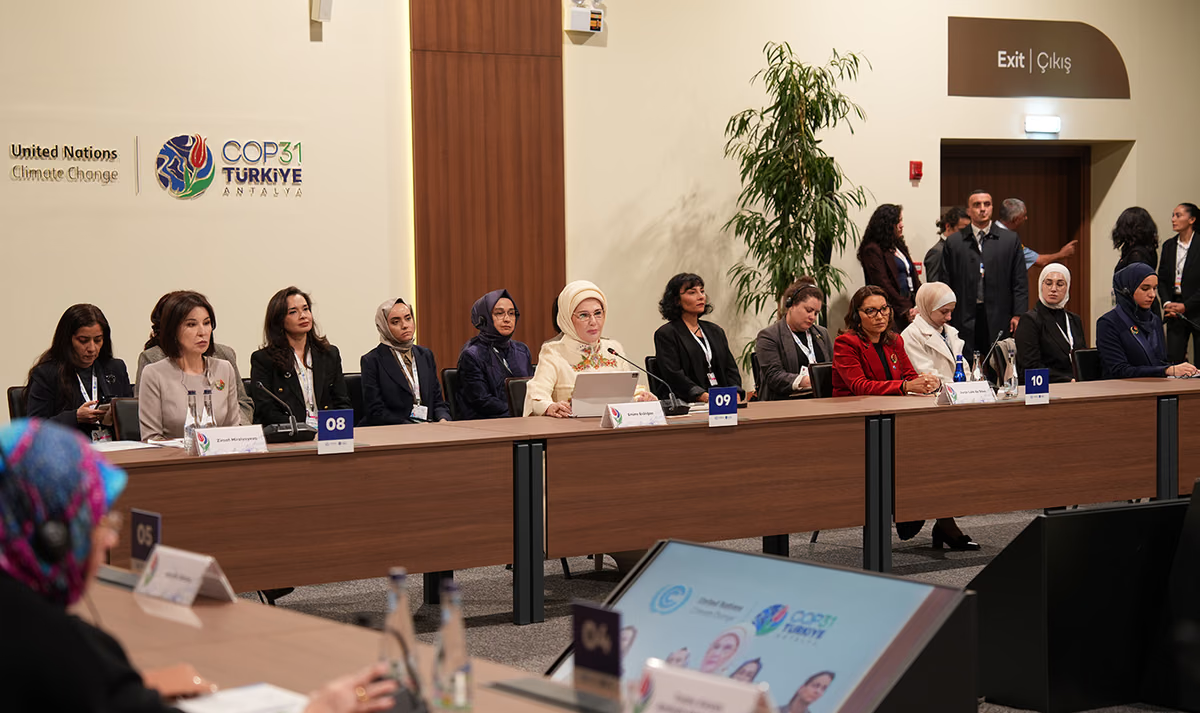
The goals and planned working structure of the Global Zero Waste Alliance were shared at the Leaders’ Spouses meeting held in Antalya as part of COP31. Her Excellency Emine Erdoğan said that, with the alliance expected to focus on five priority areas, they aim to develop lasting cooperation between countries and take local solutions to wider geographies.
At the “Global Zero Waste Alliance High-Level Meeting of Leaders’ Spouses,” held within the framework of the 31st Conference of the Parties (COP31) to the United Nations Framework Convention on Climate Change (UNFCCC), Her Excellency Emine Erdoğan, Founder of the Zero Waste Movement, Chair of the United Nations High-Level Advisory Board on Zero Waste and Honorary President of the Zero Waste Foundation, delivered a speech.
Expressing great pleasure at hosting the participants in Türkiye on the occasion of COP31, Erdoğan said that more than 100,000 participants from 195 countries and more than 100 leaders have come together to shape humanity’s shared future. Saying this participation shows both the power of collective will and the magnitude of the responsibility undertaken, she continued:
“For decades, at climate summits, we have been talking about rising temperatures, drought and forest loss, and listening to scientists’ warnings. These efforts have undoubtedly created a global awareness. But we are now in a period in which we need to go beyond the reports, warnings and targets that lay out the dimensions of the climate crisis. Because the value of knowledge is also measured by which decisions we are able to turn it into.”
Focusing on What Climate Goals Mean in Daily Life
Erdoğan stressed that the fundamental problem is not that what needs to be done is unknown, but that the will to put what is known into practice must be shown. In this context, she described Türkiye’s COP31 approach and the development of the Zero Waste Movement in these words:
“This is why, as Türkiye, we have defined COP31 as an action COP. We want to measure success not only by the commitments made but by the change they create in people’s lives, in our cities and in our ways of production. The Zero Waste Movement we started 9 years ago is a concrete example of this understanding. The awareness that began in homes has today turned into a system reaching from schools to municipalities and from public institutions to factories. In this process, our country’s recovery rate rose from 13 percent to over 37 percent. More importantly, a sense of responsibility has developed that finds a place in the daily lives of people of all ages.”
Saying the most important lesson they learned in the process was that waste does not begin in the trash bin but in the decisions made, Erdoğan said that whether a product is truly necessary, how it is produced and how long it is used determine the waste that will arise.
Prevented Waste Should Also Be Counted in Measuring Success
Recalling that for years more production was regarded as development and more consumption as a sign of prosperity, Erdoğan explained that in the next stage recycling waste was regarded as success. Despite the value of recycling, she said, land, water, energy and labor are spent even to produce the best-managed waste, adding: “We must measure our success not only by the waste we recover but also by the waste we prevent from being created. Reaching a higher quality of life with fewer resources should be at the center of our understanding of development.”
Asking, “If waste begins in decisions, we must ask who makes these decisions,” Erdoğan assessed the effects of global production and consumption models as follows:
“A significant part of the pressure on our natural resources arises from global production and consumption models. We talk about the harms of tobacco to health. Yet according to the World Health Organization, the tobacco industry causes the loss of 600 million trees and the consumption of 22 billion tons of water every year. Similarly, in a world where the fashion and textile sector produces 92 million tons of waste a year, we cannot explain the increasingly short lifespan of products only by consumers’ preferences. In the digital world, alongside business models aimed at keeping us on screens longer, we must also question the energy and water needs of the growing infrastructure.”
An Emphasis on Environmental Responsibility for Technology and Companies
Noting that artificial intelligence offers great opportunities for reducing waste, increasing efficiency in production and developing new solutions to environmental problems, Erdoğan continued her assessment:
“But we cannot evaluate technological progress separately from its environmental costs. We cannot build the technologies of the future on the wasteful habits of the past. The price of a company’s economic gain should not be another society’s depleted water resources or polluted soil. For this reason, we must develop common standards that make large companies’ resource use transparent, open their environmental impacts to independent assessment and strengthen accountability. The responsibility of companies operating on a global scale must also be global.”
Attention Drawn to the Long-Term Effects of the Destruction in Gaza
Referring also to Gaza, where destruction has appeared most severely, Erdoğan said that, according to the United Nations Environment Programme, 61 million tons of debris have accumulated in the region. She said 97 percent of orchards and olive groves have been destroyed and most of the remaining freshwater sources have been polluted.
Noting that recovery from this destruction could take generations, Erdoğan said: “At a time when global military spending has reached a historic record of 2.9 trillion dollars, let us think for a moment about what could be possible if even a small part of these resources were devoted to humanity’s shared problems. Destroyed cities could be rebuilt, barren lands could be revived and peace could be the climate of all continents.”
Five Priority Areas and Three Complementary Structures
Stating that no country can change the decisions made in homes, in production and in politics on its own, Erdoğan explained the goals and planned areas of work of the Global Zero Waste Alliance as follows:
“The Global Zero Waste Alliance, which we are introducing today, is an expression of our will to turn this shared responsibility into lasting cooperation. With our alliance, we aim to create a strong cooperation ground where countries learn from one another’s successful practices, develop joint projects and spread local solutions on a global scale. We plan to carry out work in 5 priority areas: zero waste and circular economy, plastic and packaging waste, zero waste districts, food and organic waste, and education and youth. We plan to develop this work through 3 complementary structures.”
Announcing that common priorities and solution proposals will be addressed at the Zero Waste Forum held every year, Erdoğan said they will contribute, through the Istanbul Platform, to turning these proposals into concrete projects and implementation partnerships.
Stating that they aim to take the Global Zero Waste Alliance’s work to wider geographies and encourage new cooperation between countries, Erdoğan said: “In this way, we aim to bring international organizations, local governments, academia, the private sector and civil society together around shared goals. These problems cannot be solved by the efforts of a single country; we must bring together our knowledge, our means and our experience.”
An Invitation to Leaders’ Spouses to Become Active Stakeholders
Stating that each leader’s spouse at the meeting has a sphere of influence that can make an important contribution to the transformation, Erdoğan explained that leaders’ spouses can reach different segments of their societies and bring public institutions, civil society and the business world together around shared goals.
Pointing out that support given to a small local initiative can start a wider change, Erdoğan invited leaders’ spouses to become active stakeholders of the Global Zero Waste Alliance. She asked them to bring their countries’ experience and successful practices to this joint work.
Thanking the leaders’ spouses for their participation and for their sensitivity to our shared future, Erdoğan wished that the alliance would be beneficial for countries and for all humanity.
Leaders’ Spouses and Representatives of International Organizations Took the Floor
After Emine Erdoğan, Janja Lula da Silva, spouse of the President of Brazil; Ziroat Mirziyoyeva, spouse of the President of Uzbekistan; Ancelly Simina, spouse of the President of Micronesia; Sajidha Mohamed, spouse of the President of the Maldives; Gueta Selemane Chapo, spouse of the President of Mozambique; and Nilden Bektaş Erhürman, spouse of the President of the TRNC, gave speeches.
Francine Ntakarutimana, spouse of the Head of Government of Burundi; Zubaida Rahman, spouse of the Prime Minister of Bangladesh; Zainab Suleman, daughter-in-law of the Prime Minister of Pakistan; Alexander De Croo, Administrator of the United Nations Development Programme; and Ancaludia Rossbach, Executive Director of UN-Habitat, also took the floor at the meeting.
Participants of the program included Mariem Dah, spouse of the President of Mauritania; Latife El Durubi, spouse of the President of Syria; Valerie Whipps, spouse of the President of Palau; Mirela Becirovic, spouse of the Chairman of the Presidency of Bosnia and Herzegovina; Tunku Azizah Aminah Maimunah, spouse of the Sultan of the Malaysian state of Pahang; Ambari Daroueche Azali, spouse of the President of the Comoros; and Philile Dlamini, spouse of the Prime Minister of Eswatini.
Zinash Tayachew, spouse of the Prime Minister of Ethiopia; Amina El-Dilawi, spouse of the Prime Minister of the Government of National Unity of the State of Libya; Ann Marie Davis, spouse of the Prime Minister of the Bahamas; Tausaga Teo, spouse of the Prime Minister of Tuvalu; Leyla Aliyeva, daughter of the President of Azerbaijan; Zahra Pezeshkian, daughter of the President of Iran; Samed Ağırbaş, President of the Zero Waste Foundation and COP31 High-Level Climate Champion; and members of the UN High-Level Advisory Board on Zero Waste also attended the program.