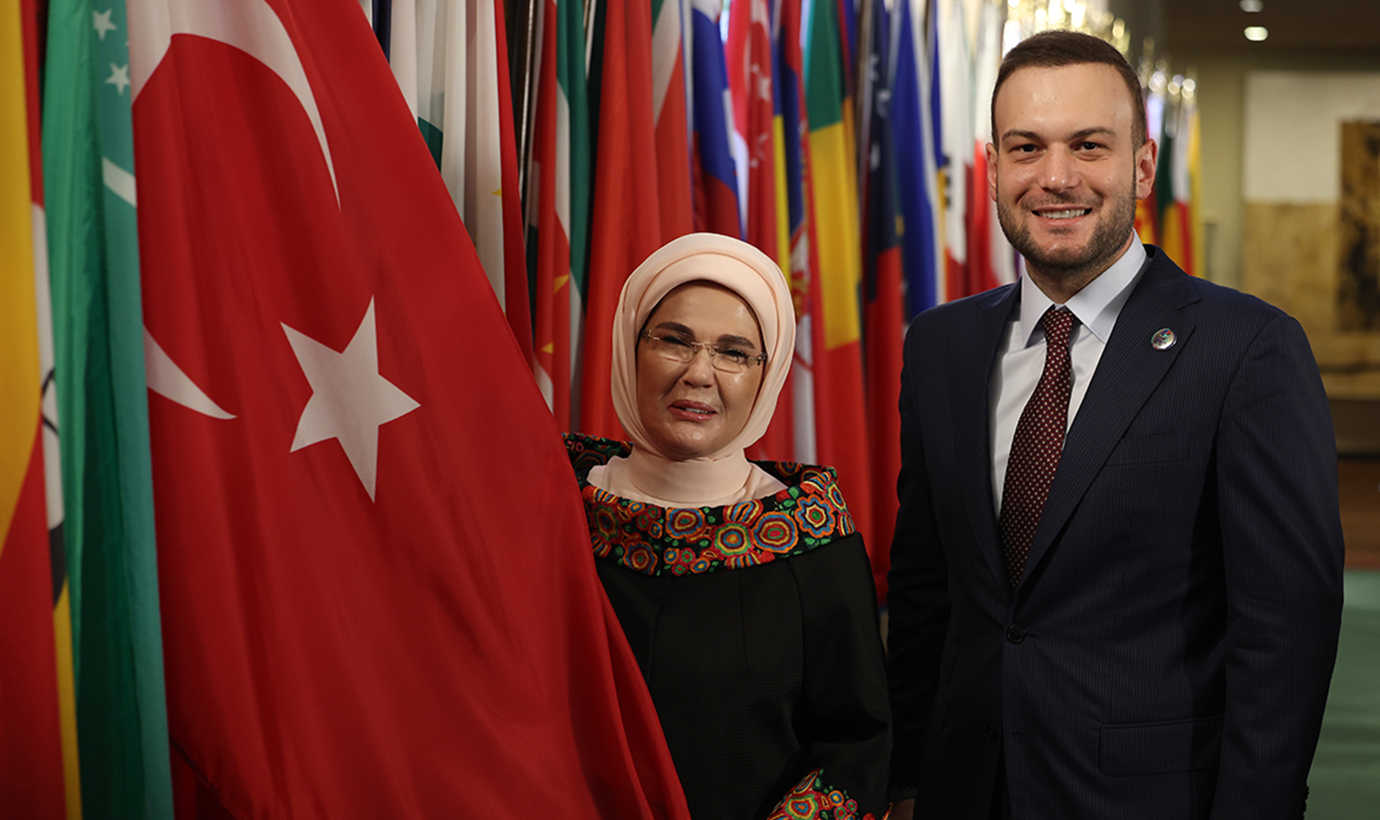
The Mediterranean Climate Summit addressed the role of cities in climate action, regional resilience and the Zero Waste approach. Samed Ağırbaş, President of the Zero Waste Foundation and COP31 High-Level Climate Champion, emphasized that the success of COP31 will be measured not only by decisions taken in Antalya, but also by concrete implementation in cities and regions.
In line with the vision put forward by Ms. Emine Erdoğan, Founder of the Zero Waste Movement, Chairperson of the United Nations Advisory Board of Eminent Persons on Zero Waste and Honorary Chairperson of the Zero Waste Foundation, the Zero Waste approach originating in Türkiye and spreading globally continues to gain recognition in the areas of climate action, resource efficiency and the circular economy.
During Türkiye’s COP31 Presidency process, implementation-focused efforts coordinated by Murat Kurum, Minister of Environment, Urbanization and Climate Change and President of COP31, aim to support climate targets through concrete steps extending from cities to regions.
Regional Resilience on the Agenda at the Mediterranean Climate Summit
The local reflections of this approach were discussed at the Mediterranean Climate Summit held in Muğla. Organized on 28-29 September through cooperation between Muğla Metropolitan Municipality and Türkiye & ICLEI Europe – Local Governments for Sustainability, the summit evaluated the Mediterranean Basin’s vulnerability to climate change and its capacity for joint solutions.
Held at the Türkan Saylan Contemporary Life Center, the summit addressed climate resilience in cities, water scarcity, drought, forest fires, extreme heat, floods, marine ecosystems and biodiversity, as well as regional cooperation opportunities in climate adaptation, just transition, climate finance, loss and damage.
Cities Take Center Stage in the Mediterranean Climate Agenda
Bringing together representatives of cities and regions, local governments, academia, civil society and international organizations, the summit aimed to develop a common Mediterranean perspective toward COP31.
In this context, participants aim to prepare the MED Climate Declaration, which will outline the region’s priorities and key messages for COP31.
Representatives at the Summit
The summit was attended by Samed Ağırbaş, President of the Zero Waste Foundation and COP31 High-Level Climate Champion, along with United Nations Resident Coordinator in Türkiye Dr. Babatunde Ahonsi, Deputy Governor of Muğla İsmail Soykan, Muğla Metropolitan Municipality Mayor Ahmet Aras, Menteşe Mayor Gonca Köksal Aras, ICLEI Vice President Mohamed Sefiani and Deputy Secretary-General of the Union of Municipalities of Türkiye Feridun Ulutaş.
Ağırbaş: “The Role of Local Governments is Extremely Critical for the Future of the Mediterranean”
Drawing attention to the Mediterranean as one of the regions experiencing the impacts of the climate crisis intensely, Samed Ağırbaş, President of the Zero Waste Foundation and COP31 High-Level Climate Champion, emphasized the role of cities in climate action.
Ağırbaş stated that the Zero Waste Movement, originating in Türkiye under the leadership of Ms. Emine Erdoğan and gaining global recognition, has become a global vision, while highlighting the importance of the strong coordination and implementation-oriented approach led by Murat Kurum, Minister of Environment, Urbanization and Climate Change and President of COP31.
Action Plan to Combat Plastic Waste in the Mediterranean
Stating that the Mediterranean Basin holds particular importance for the Zero Waste Foundation, Ağırbaş provided information about efforts addressing the region’s plastic waste problem.
“In this context, we recently held the Türkiye Plastic Waste Workshop in Istanbul. We have prepared a strong action plan concerning the plastic waste crisis that has recently emerged along the Mediterranean shores. We will soon present this action plan to the appreciation of our nation. Climate and environmental issues can be local and regional. But as you know, climate issues such as global warming are global matters. Solutions to these global problems can differ in every province and sometimes in every village. Therefore, as the Zero Waste Foundation, we recognize the importance of local governments and work in cooperation with various international organizations representing local governments.”
Ağırbaş noted that drought, water scarcity, extreme heat, forest fires, floods and biodiversity loss in the Mediterranean are no longer projections concerning the future, but have become challenges that cities are facing today.
“The issue is not merely an environmental policy matter; it concerns the resilience of our cities, our water and food security, the future of our economies and the living spaces we will leave to future generations,” Ağırbaş said, emphasizing that although the impacts of the climate crisis are global, a significant part of the solution is implemented in cities.
Zero Waste as a Tool for Climate Action on the Ground
Ağırbaş noted that waste management, water efficiency, reducing food waste, energy efficiency and the circular economy are not independent areas, but interconnected components of the same transformation.
Referring to the results of Türkiye’s Zero Waste experience in protecting resources and transitioning to a circular economy, Ağırbaş stated that in the ninth year of the Movement, the recovery rate had increased from 13 percent to around 40 percent, more than 90 million tons of waste had been returned to the economy and approximately 400 billion Turkish liras in economic contribution had been generated.
Zero Waste Forum
Recalling that the Zero Waste Forum held in June brought together participants from 183 countries, Ağırbaş stated that the Zero Waste approach has evolved into an area of implementation directly connected with climate action.
Ağırbaş stated, “Zero Waste is now not only part of waste management, but also part of climate action.”
The Impact of COP31 Will Extend Beyond Antalya
Emphasizing that the success of COP31 cannot be measured solely by decisions taken in conference halls, Ağırbaş stated that the real measure will be the concrete change that emerges in cities, regions, businesses and communities after Antalya.
“The success of COP31 cannot be measured solely by decisions taken in conference halls. Real success will be measured by the concrete change that emerges in our cities, regions, businesses and communities after Antalya. For this reason, I consider it extremely valuable for the Mediterranean to have a strong voice on the road to COP31. I believe that the joint MED Climate Declaration we will prepare here today will also make an important contribution in this regard. Because if the problems of the Mediterranean are shared, our solution must also be shared. Public institutions, local governments, the private sector, academia, civil society and citizens must come together around the same goal.”
Ağırbaş stated that this approach also aligns with the implementation focus of COP31 and emphasized the importance of Mediterranean cities developing joint solutions to shared challenges.
“Our Resources Are Not Unlimited, but Our Capacity to Develop Solutions Is”
Ağırbaş stated that the Mediterranean should be considered not only as a region experiencing the impacts of the climate crisis, but also as a center that develops solutions and carries those solutions to the world.
“Our resources are not unlimited. But our capacity to develop solutions is. As long as we act together. As long as we build strong partnerships from the local to the global level. As long as we connect climate targets with implementation on the ground.”
Ağırbaş concluded by expressing his hope that the Mediterranean Climate Summit would strengthen common understanding, generate new cooperation among cities and bring a strong Mediterranean perspective to COP31.