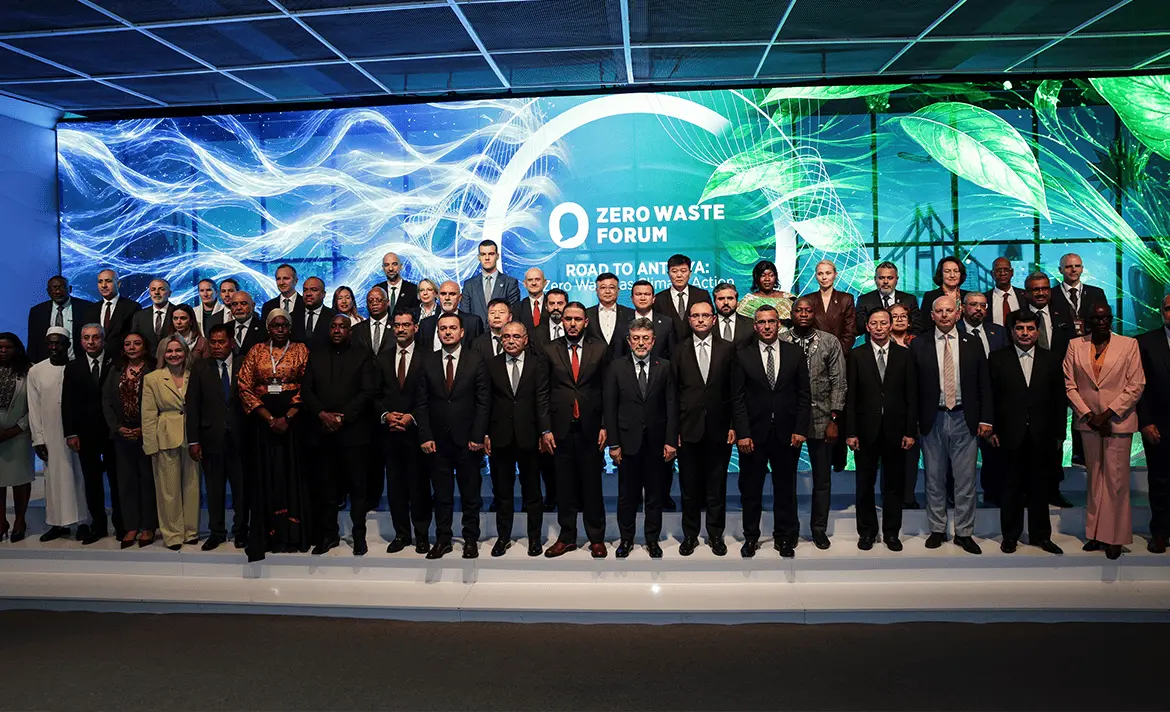
Within the scope of the Zero Waste Forum organized by the Zero Waste Foundation in Istanbul, an important global initiative that will strengthen the role of cities in climate action has been launched.
The Global Zero Waste Zones Initiative was introduced to the public within the scope of the Zero Waste Forum 2026, held under the auspices of First Lady Emine Erdoğan, Founder of the Zero Waste Movement, Chair of the United Nations Advisory Board of Eminent Persons on Zero Waste, and Honorary President of the Zero Waste Foundation.
Announced by Samed Ağırbaş, President of the Zero Waste Foundation and COP31 United Nations High-Level Climate Champion, the initiative aims to support cities in transforming their zero waste goals into concrete, measurable, and implementable transformation programs.
Drawing attention to the decisive role of cities in the climate struggle during the COP31 process, the initiative aims to contribute to local governments implementing circular economy models, increasing resource efficiency, and creating low-carbon urban systems.
Cities Will Be the Implementation Centers of Global Climate Action
The Global Zero Waste Zones Initiative stands out as a comprehensive transformation model that brings together the goals of combating climate change, sustainable development, efficient use of resources, and the circular economy, rather than merely being a waste management program.
In the introduction of the initiative, Samed Ağırbaş stated that the zero waste approach is a holistic climate action model encompassing all segments of society beyond environmental limits, expressing that cities are among the most important actors of this transformation.
Within the scope of the initiative, which draws attention to the fact that cities are at the center of both the impacts and solutions of the climate crisis due to their population, production, and consumption densities; it is aimed to strengthen the implementation capacity of municipalities' zero waste commitments, popularize local solutions, and share successful models on a global scale.
The New Local Implementation Area of the Zero Waste Movement
The Zero Waste Movement, spreading from Türkiye to the world under the pioneering of First Lady Emine Erdoğan; is today recognized as a global transformation model in a wide area from combating climate change to the circular economy, and from sustainable cities to resource efficiency.
The Global Zero Waste Zones Initiative, on the other hand, is positioned as a new mechanism that will ensure the implementation of this vision at the city scale.
In the "Cities Day" sessions held within the scope of the Zero Waste Forum; mayors from different regions of the world, city networks, development agencies, and financial institutions came together to evaluate the role of zero waste policies in helping cities reach their climate goals.
In the round-table meetings, cooperation areas aimed at increasing the implementation capacity of local governments, developing financing models, and strengthening knowledge sharing among cities were addressed.
The First Pilot Zone Determined
In the initial implementation phase of the Global Zero Waste Zones Initiative, three cities from different continents were determined as pilot zones.
Mexico City, the capital of Mexico, Kisumu city in Kenya, and George Town city in Malaysia; will be the pioneering implementation areas of the models to be developed in the fields of waste prevention, organic waste management, resource efficiency, reuse systems, and circular economy practices.
With the works to be carried out in the pilot zones, it is aimed to;
• Reduce waste generation at the source,
• Increase the recovery of organic waste,
• Reduce methane emissions,
• Strengthen the culture of reuse and repair,
• Develop circular business models,
• Include local stakeholders in the process.
It is targeted to transform the gained experiences into exemplary models that can be applied by different cities.
International Cooperation for Reducing Methane Emissions
Within the scope of the initiative, the development of international partnerships on reducing methane emissions originating from organic waste is also planned.
In this context, while cooperation opportunities with the Global Methane Hub are evaluated, it is emphasized that zero waste applications are one of the effective tools directly providing emission reductions in the fight against climate change.
More effective management of organic waste will contribute not only to reducing the amount of waste but also to cities achieving their climate goals.
Transformation Starting Locally Will Turn into a Global Climate Gain
One of the main goals of the Global Zero Waste Zones Initiative is to transform cities from merely being areas that realize their own transformation into solution centers that guide global climate action.
Within the scope of the initiative, it is aimed for cities to set measurable goals, share implementation results, and develop models that will set an example for other cities.
The Zero Waste Foundation continues its work with the understanding that transformation starting from the daily life practices of cities can create impacts on a global scale.
A New Global Step in the Process Leading to COP31
The Global Zero Waste Zones Initiative is evaluated as an important step placing cities at the center of climate action in the process leading to COP31.
Representing the new stage of the Zero Waste Movement growing under the pioneering of First Lady Emine Erdoğan, the initiative brings together the goals of the circular economy, resource efficiency, emission reduction, and sustainable urbanization on a common ground.
With this new model spreading from Istanbul to the world, it is aimed to contribute to cities transforming into more resilient, more sustainable living spaces that are more livable for future generations.


