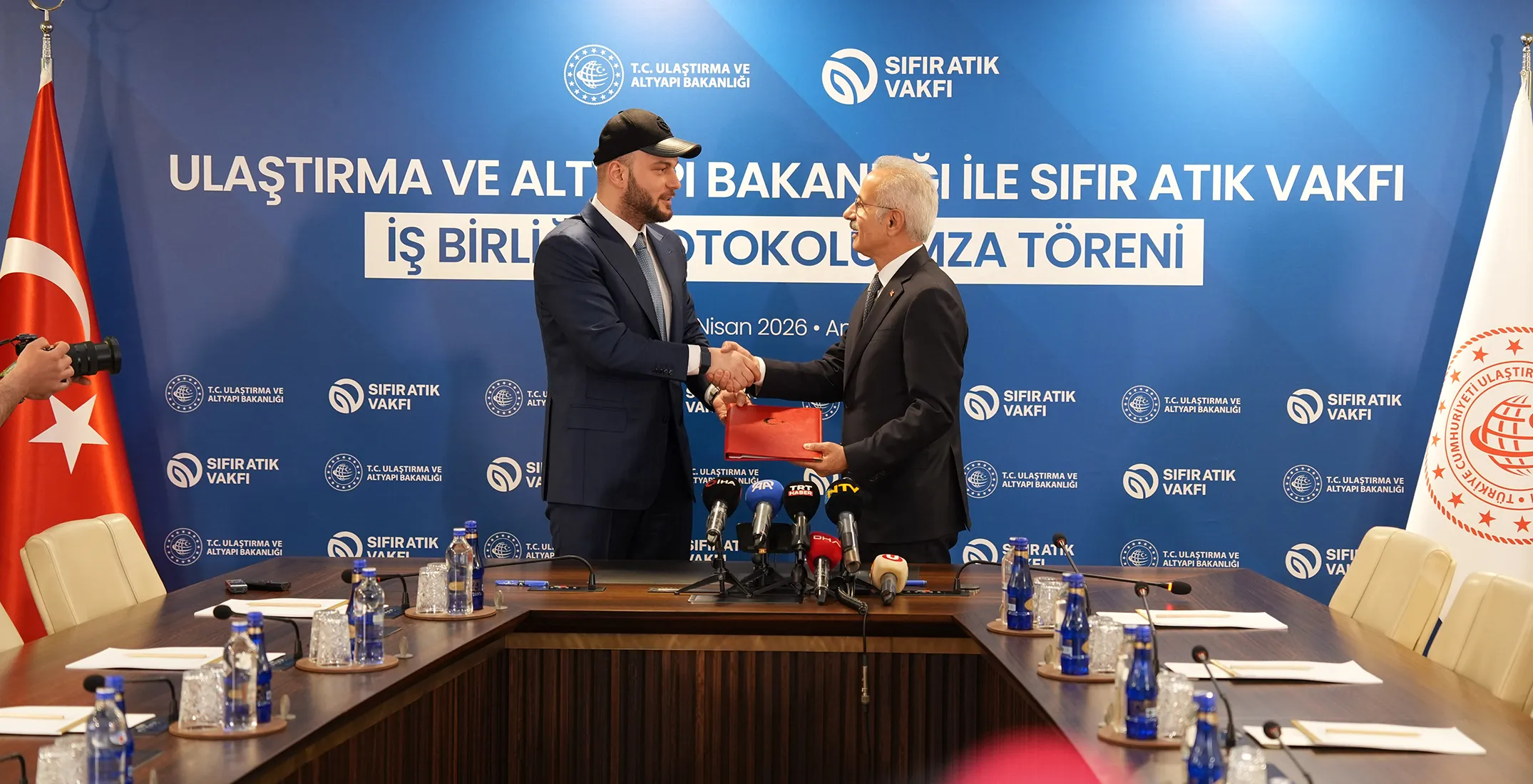
In line with Türkiye's sustainable development goals, a comprehensive Cooperation Protocol was signed between the Zero Waste Foundation and the Ministry of Transport and Infrastructure. Aiming to systematically expand the zero waste approach in the transport and infrastructure sectors, reduce environmental impacts, and strengthen sustainable transport models, this important step marks the beginning of a multi-stakeholder and long-term transformation process.
The Zero Waste Foundation, continuing its activities on a national and global scale under the vision and auspices of First Lady Emine Erdoğan, Founder of the Zero Waste Movement, Chair of the United Nations Advisory Board of Eminent Persons on Zero Waste, and Honorary President of the Zero Waste Foundation, brings a new momentum to Türkiye's environmental sustainability policies with this cooperation.
In this framework, the protocol signed with the participation of Mr. Samed Ağırbaş, President of the Zero Waste Foundation and COP31 High-Level Climate Champion, and Mr. Abdulkadir Uraloğlu, Minister of Transport and Infrastructure, puts forward a holistic roadmap for expanding the zero waste approach in the fields of transport and infrastructure, promoting sustainable transport practices, and minimizing environmental impacts. The protocol also establishes a strong ground for coordination and cooperation among the public sector, private sector, academia, and civil society.
A New Integration Process in Transportation Policies
Samed Ağırbaş, President of the Zero Waste Foundation and COP31 High-Level Climate Champion, stated in his speech at the signing ceremony that Türkiye will host two important international events this year, saying, "One is the Zero Waste Forum to be held on June 5-7. Representatives from more than 150 countries will attend the forum. We will host more than 100 ministers and over 5,000 participants globally. The forum, which we are holding together with our universities in Türkiye, as well as the world's best universities like Harvard and Cambridge, and organizations such as the World Bank and the United Nations, holds the distinction of being the world's largest and most comprehensive zero waste climate and environment meeting."
Emphasizing that the Ministry of Transport and Infrastructure will also actively be involved in the process with the aforementioned protocol, Ağırbaş drew attention to the importance of the investments Türkiye has made in the field of transport and infrastructure under the leadership of President Recep Tayyip Erdoğan.
Strengthening Sectoral Capacity and International Vision
Expressing that the transportation investments realized in Türkiye are appreciated on a global scale, Ağırbaş thanked President Recep Tayyip Erdoğan and Minister Abdulkadir Uraloğlu for these investments.
Reminding that Türkiye will host COP31 within the scope of the United Nations Framework Convention on Climate Change, Ağırbaş stated that efforts to increase multi-stakeholder participation in the process are ongoing, saying, "We are working on the participation of disadvantaged groups, universities, and state-owned enterprises in the process globally. With the protocol we are signing today, under the leadership of our Honorable Minister, we will further strengthen the works related to the transport and infrastructure sector in the context of zero waste in Türkiye."
Furthermore, expressing that the Ministry will be among the stakeholders within the scope of the forum to be held, Ağırbaş stated that Türkiye's transport and infrastructure projects will be shared on international platforms and strategies for reducing carbon emissions will be discussed in widely participated environments.
The Critical Role of Transportation in the Climate Struggle
In his speech, Minister of Transport and Infrastructure Abdulkadir Uraloğlu expressed that the Zero Waste Movement, initiated in 2017 under the pioneering leadership of First Lady Emine Erdoğan, spouse of President Recep Tayyip Erdoğan, has originated in Türkiye and become a global transformation model resonating in 193 countries today.
Emphasizing that the transportation sector has played a decisive role in the development of civilizations throughout historical processes, Uraloğlu made the following assessment regarding its environmental impacts today:
"Today, the transportation sector ranks third globally with a share of approximately 21 percent among the sectors causing greenhouse gas emissions, and second in Türkiye with a share of 17.6 percent. These data clearly demonstrate that the transportation sector plays or should play a critical role in combating climate change."
Stating that factors such as global climate change and the limits of natural resources are forcing the sector into transformation, Uraloğlu emphasized that this transformation is not only a necessity but also a responsibility towards future generations.
Transition to High-Level Standards in Waste Management
Expressing that the protocol signed with the Zero Waste Foundation is a concrete reflection of this sense of responsibility, Uraloğlu stated that as the Ministry, they have built a significant institutional capacity in the field of environmental sustainability.
In his evaluation regarding the scope of the protocol prepared in line with the 2053 net zero emission target, he used the following expressions:
"The protocol was prepared with the aim of expanding the zero waste approach in the transport and infrastructure sectors, increasing resource efficiency, preventing waste generation, adopting the circular economy model, and promoting green infrastructure practices. With the protocol, we will maximize waste management in our transportation projects, increase the use of recyclable materials in construction and maintenance processes, standardize zero waste practices in our ports, airports, and stations, and spread sustainable transportation awareness to our passengers, employees, and stakeholders. With the responsibility of being the first ministry in Türkiye to calculate its corporate carbon footprint, we shape every project with the principles of environmental sustainability."
Uraloğlu expressed that as the Ministry, they will continue to develop concrete projects in cooperation with the Zero Waste Foundation and resolutely continue their efforts towards the goal of a cleaner environment.
Following the speeches, Uraloğlu and Ağırbaş signed the Cooperation Protocol.
Transformation Supported by Education, R&D, and Technical Collaborations
Within the scope of the protocol, educational programs, workshops, seminars, and technical collaborations will be implemented to strengthen environmental sustainability in the fields of transport and infrastructure.
The Ministry of Transport and Infrastructure will contribute to the expansion of good practice examples in the sector by sharing its knowledge and institutional capacity acquired in national and international activities with the Zero Waste Foundation.
The Zero Waste Foundation, on the other hand, will take an active role in the processes of project development, awareness raising, and bringing international best practices to Türkiye in the fields of sustainable transportation, green infrastructure, and mitigation of environmental impacts. In this context, it is aimed to achieve concrete gains towards reducing transport-induced waste and increasing resource efficiency.
Multi-Stakeholder Governance and Integration into Global Platforms
Within the framework of the protocol, the parties will conduct planning, implementation, and evaluation processes on the basis of collective wisdom, and carry out communication and promotional activities in coordination.
Furthermore, this cooperation will also pave the way for the development of joint efforts that will strengthen Türkiye's leadership role on international platforms such as the Zero Waste Forum to be held in Istanbul on June 5-7, and the 31st Conference of the Parties (COP31) to the United Nations Framework Convention on Climate Change to be hosted by Türkiye on November 9-20.
Mutual contributions to be provided in areas such as supporting academic research, data sharing, curriculum development, and increasing technical capacity will make significant contributions to the holistic strengthening of the sustainability ecosystem.
Systemic Transformation with the Zero Waste Approach
The Zero Waste approach stands out as a comprehensive paradigm that transforms all systems from production to consumption, from urbanization to transportation, rather than being limited merely to environmental policies. The Zero Waste Foundation continues to carry this understanding to a wider sphere of influence in line with Türkiye's sustainable development vision.
The adoption of this approach in high-impact capacity sectors such as transport and infrastructure will increase economic efficiency as well as environmental gains, optimize resource utilization, and contribute to leaving a more livable world for future generations.
Türkiye's Zero Waste vision constitutes a strong call for transformation extending from the local to the global. Every step taken in line with this approach, which demonstrates that development in harmony with nature is possible, shapes not only today but also the world of the future. This cooperation established between the Zero Waste Foundation and the Ministry of Transport and Infrastructure stands out as a strategic turning point on the path to a sustainable future.


